Yeah, it is and the math get's really counterintuitive to grasp since humans (at least me) have trouble thinking in exponential terms.
If you accelerate at 1g constantly for 1y you travel 0.5 light years. You do that for 10.5 years and you reach the center of the milky way. You do that for another 4 (~14 total) years and you are in the Andromeda galaxy, and you do that for another 10 years (~24 years total) and you reach what today is considered the edge of the observable universe.
By the time you get there you are basically traveling at a rounding error from C.
We can't do it with any rocket-like propulsive technology. By the time you get anywhere close to c the front of your spacecraft is being abraded into nothing by interstellar gas, larger particles of dust will kill you, and colliding with anything bigger creates an explosion that can be seen for light years. You need to be flying a large asteroid to even think about surviving it - you still won't for long, but you will have time to think about it - and the energy requirements are wildly impractical.
Magic warp bubble tech is the bare minimum, and we're nowhere close to inventing that.
Sadly there is no realistic approach to get there (even assuming fantasy-levels of technology).
Chemical rockets are currently the only thing that allow sustaining such accelerations briefly for human-size payloads, but the low exhaust velocity and exponential reaction mass requirement make sustaining it for days/months/years completely impossible.
You'd have to supply the energy externally (i.e. some sort of beam propulsion), but getting any significant fraction of g out of such a system (with human-sized payloads) seems unlikely within the next centuries, especially as the distance increases.
> You'd have to supply the energy externally (i.e. some sort of beam propulsion), but getting any significant fraction of g out of such a system (with human-sized payloads) seems unlikely within the next centuries, especially as the distance increases.
Or some form of ram scope, plenty of H everywhere, but those also have the issue of you collecting things while going at relativistic speeds.
We can easily accelerate past 1g... 1g is just chosen for human comfort, but running any rocket engine continuously for a year requires an impossible amount of fuel.
Not with current technology. That was kind of the physics “trick” in the book ‘Project Hail Mary’, where the astrophage provided enough energy and propulsion to be able to sustain 1G of acceleration.
We need a massive rocket to escape the earths gravity (1g). That takes us minutes and a crap ton of fuel. The issue is to keep doing that with fuel and oxidiser constantly for 1, 2 or 10 or 25 years is a monumental amount of energy, which is a monumental amount of weight, which is a monumental amount of volume... Also you also need the exact same amount of fuel to stop again.... So yeah ... We don't got it yet
It's hard to accelerate at or beyond 1G for very long with current technology. Roughly speaking, the rocket runs out of fuel soon. Packing more fuel makes the rocket heavier, meaning diminishing returns when using the fuel. The mass required grows exponentially. See "The tyranny of the rocket equation"
People always say that about speed of light stuff, but I don’t get it. Do you have any more examples of counterintuitive math?
Because what you’re describing is basically the equivalent to compound interest in finance. (e.g. investing $100 at 10% interest over 10 years results in $260)
The proper time (that is, the time the traveler measures on a clock) goes to zero very quickly towards the end. Even with both axes plotted logarithmically, it's just a sudden drop at the end towards light speed.
Funnily enough, I use Cloudflare Warp at work, and it breaks my site for what I think are DNS related reasons. Maybe there are some more exotic DNS keys that I need to add.
Or I could go back to IPv4 with dynamic DNS, but that would mean changing domain registrars.
NS record for domains usually can be pointed at someone else than the registrar it's on, just fine(unless DNS infra of either one or both goes down). That's entirely separate to registrar transfer.
It’s the units that make it seem unintuitive. 12 days is roughly 0.032 years, and 17 minutes is likewise 0.000032 years. It’s relative to how we were taught to view smaller lengths of time. Of course you could argue measuring time by the rotation of heavenly bodies is more intuitive than counting on your fingers for the hours in a day and days in a lunar cycle.
Going from a million to a billion isn't some special relationship. It's just * 1000. It's the same as going 11000 or 101000.
I find it frustrating that people seem to think that someone going from 1M to 1B is somehow different to other numerical operations. It's not. It's 1000 times bigger, it's not a huge deal.
> if we add more 9s, is it possible to reduce that number to within a human lifespan?
Yes. At 99.99999999% of c it would take 35 years from the perspective of the traveler. However, an observer on earth will still see it taking 2.5m years.
of course I meant that a human made object traveling at those speeds was theoretical, not time dilation itself. Never thought I'd have to clarify that :)
It seems that external displays are only supported on HDMI (e.g. Mac Mini) but DP Alt mode is still listed as WIP so I'd assume MacBook's with only USB-C (all of them?) can't support an external display.
you certainly have a point, though there are organizations with more journalistic integrity and freedom and a different ownership structure. But maybe not in the US any more.
Few years ago, we had Google Bard, the ancestor of Gemini, which was supposed to be an AI LLM, and when you right-clicked the page, it was a fake page with hardcoded sentences in a .js file...


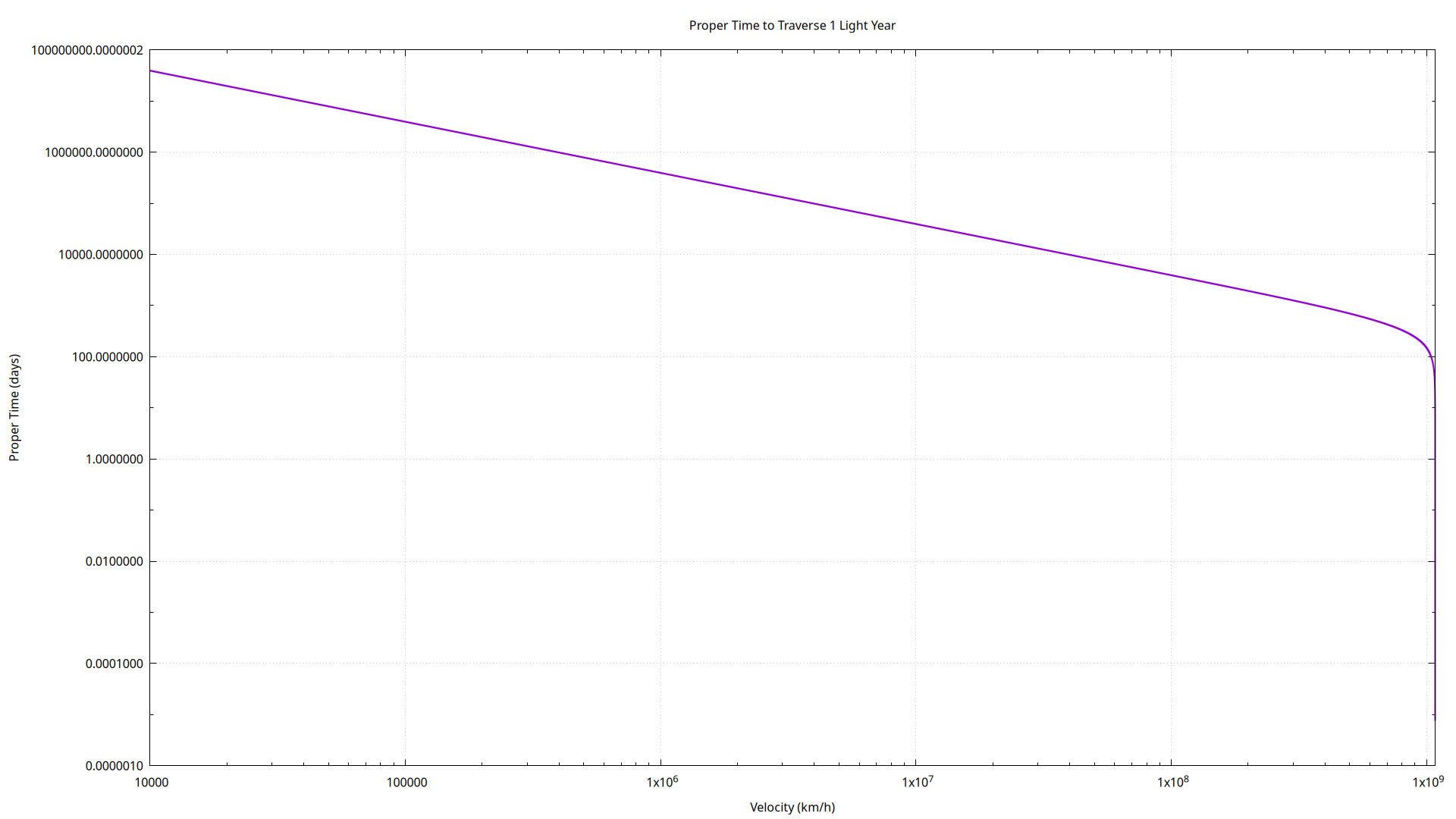
if we add more 9s, is it possible to reduce that number to within a human lifespan?
reply